
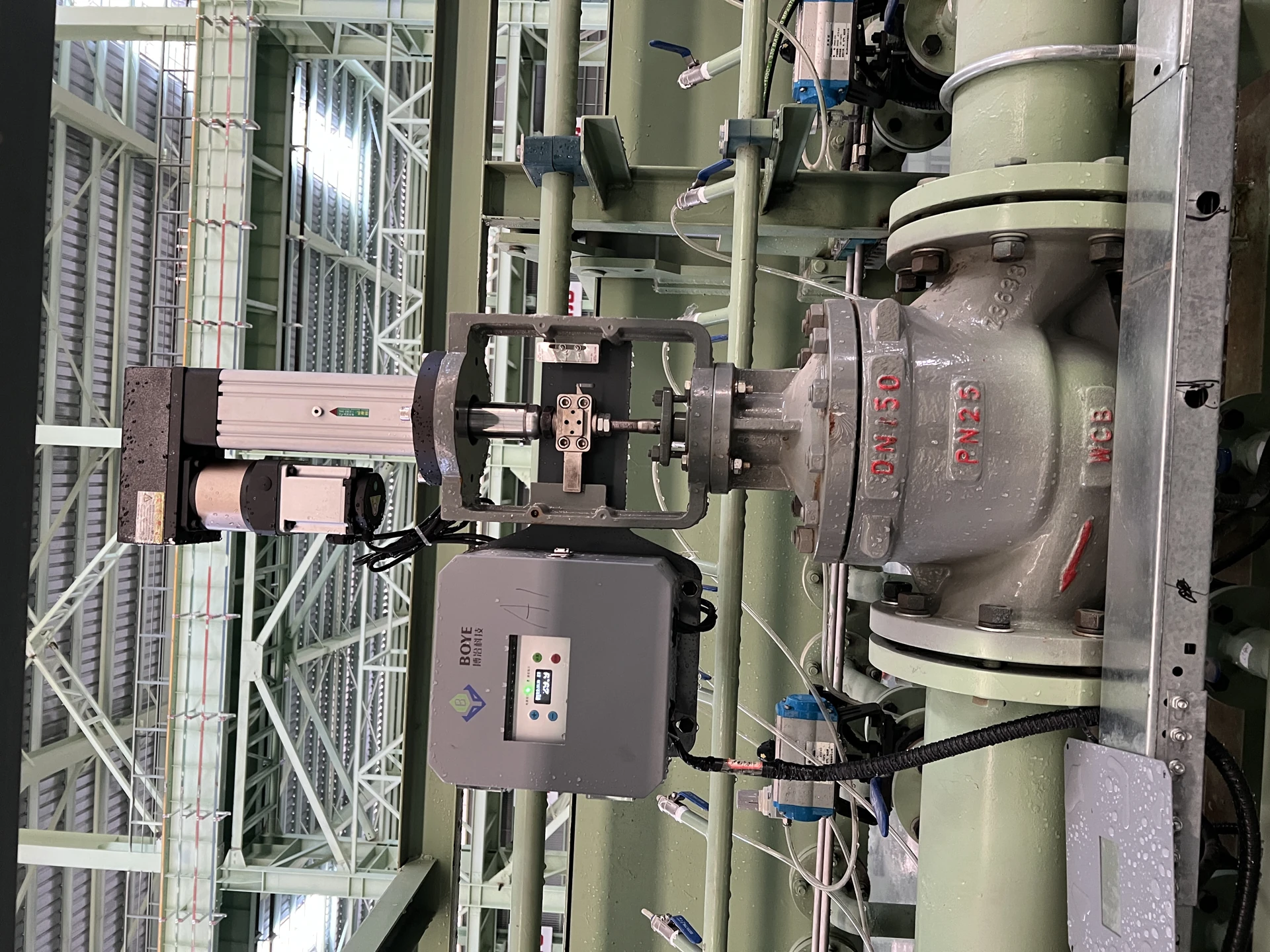
ASV Electric Servo Control Valve
Keep cooling water aligned with process demands.
Finer regulation. More stable production.
Servo motor drive provides valve positioning accuracy of 0.1% in bus and local manual modes. Full-stroke opening / closing time is under 1 second for DN25–DN32 at 100% positioning speed; other valve sizes follow the size-specific stroke times below. Designed for water cooling and continuous-casting secondary cooling, with temperature feedback and control integration.
From precise regulation to site commissioning,
improve cooling-water actuation.
Regulate cooling water more precisely
In bus and local manual modes, 0.1% valve positioning accuracy enables precise control commands. Together with closed-loop temperature control, it supports stable cooling and reduced temperature variation.
Respond to changing process conditions
Full-stroke time is under 1 second for DN25–DN32 at 100% positioning speed. Positioning speed is adjustable from 0 to 100% for rapid changes or slower fine adjustment to suit the cooling process.
Simplify site calibration
Start automatic calibration through the controller to simplify commissioning after installation or maintenance and prepare the valve for operation.
Check valve operation quickly
The OLED displays valve opening, control mode and fault information. Actual-position feedback helps verify execution and identify abnormal operation.
Key Performance Data
Valve positioning accuracy
Bus and local manual modesFastest full-stroke time
DN25–DN32 at 100% positioning speedAdjustable positioning speed
Rapid changes and precise fine adjustment0.1% refers to valve positioning accuracy in bus and local manual modes. The under-1-second headline applies to DN25–DN32 at 100% positioning speed; full-stroke times for other sizes follow the table below.
View stroke times by valve size
DN25–DN32: <0.5s; DN40–DN50: <1.5s; DN65–DN100: <2.0s; DN125–DN200: <2.5s.
Compared with a pneumatic control valve,
which areas can improve?
| Focus Area | Traditional Pneumatic Control Valve | ASV Electric Servo Control Valve |
|---|---|---|
| Air Supply & Maintenance | Requires compressed air and maintenance of air circuits and related components | Motor drive, no continuous air supply, with fewer air-circuit maintenance points |
| Regulation | Movement affected by air pressure and actuator performance | Precision positioning,adjustable movement speed, for rapid regulation and fine adjustment |
| Commissioning & Diagnostics | Usually relies on manual calibration and peripheral displays | Automatic calibration, with centralized valve position, mode and fault information |
| Control Integration | Commonly uses analog control; digital communication requires suitable configuration | Local operation, 4–20mA and Modbus RS485 |
| Power Loss | Depends on actuator and fail-position design | Holds the current valve position on power loss; select against the line’s power-loss requirements |
Servo control valve questions
Does every ASV valve complete a full stroke in under one second?
The under-1-second specification applies to DN25–DN32 at 100% positioning speed. Other sizes follow the size-specific stroke-time table on this page. Select the valve size and positioning speed against the circuit requirements.
What happens to the valve position if power is lost?
The ASV holds its current valve position on power loss. Check this behavior against the production line’s required power-loss response when planning the cooling-water circuit.
How does a servo control valve differ from an on/off valve?
The ASV regulates cooling-water flow through adjustable positioning. A servo on/off valve switches the water circuit open or closed. The two functions can be combined in a valve station.
Which control methods does the ASV support?
The ASV supports local operation, 4–20 mA control and Modbus RS485. Confirm the required control method and actual-position feedback with the existing PLC and supplied valve configuration.
Match a control valve to your cooling-water circuit.
Share valve size, water pressure and flow, existing control methods and regulation challenges.